
When Can a Shopping Centre Be Held Liable?
The owner or person in control of premises which are open to the public has a legal duty to take reasonable steps to ensure that those premises are reasonably safe for members of the public.
South African courts have repeatedly recognised this principle in cases involving accidents in shopping centres and retail stores. The duty is not to guarantee that an accident can never occur. Rather, reasonable precautions must be taken to identify foreseeable dangers and prevent members of the public from being injured.
For example, depending on the circumstances, a claim may arise where an injury is caused by:
The central question is usually whether reasonable steps were taken to prevent the accident.
A Fall Does Not Automatically Mean Someone Was Negligent
Simply proving that you fell and suffered an injury is not necessarily enough to establish a successful claim.
Generally, a claimant must establish that a dangerous condition existed, that the responsible party failed to take reasonable precautions in relation to that danger, and that this failure caused the injury and resulting loss.
South African courts have confirmed that shopping centres and retailers are expected to implement reasonable systems for identifying and dealing with hazards. What constitutes a reasonable system will depend on the circumstances.
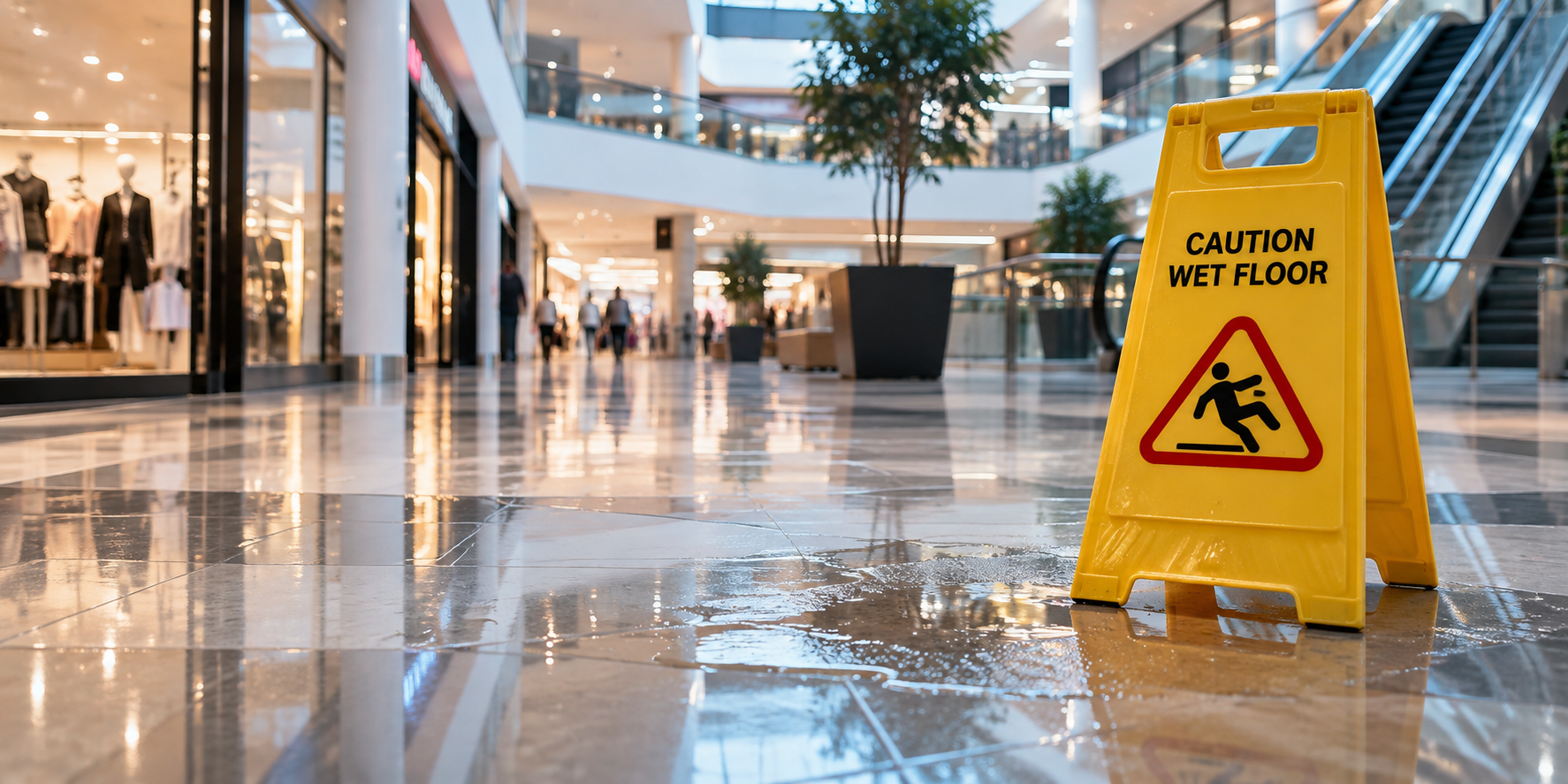
For example, if liquid has been lying on the floor of a busy supermarket for a significant period without being cleaned or warning signs being placed around it, there may be grounds for alleging negligence.
The position may be different if another customer spills a drink immediately before someone slips on it, giving staff no reasonable opportunity to discover and remove the hazard.
Every matter therefore has to be considered on its own facts.
Who Can Be Held Responsible?
Determining who is legally responsible is not always as simple as identifying the name of the shopping centre.
Depending on where and how the accident occurred, potential liability could rest with:
- The owner of the shopping centre
- The company responsible for managing the centre
- An individual retailer
- A cleaning or maintenance contractor
- Another person or entity responsible for the dangerous condition
There may also be more than one potentially responsible party.
Establishing exactly where the accident occurred and who had control over that particular area is therefore an important part of investigating a claim.
What If There Was an “Enter at Your Own Risk” Sign?
Shopping centres and other businesses sometimes display notices attempting to exclude or limit liability for injuries suffered on their premises.
The existence of such a notice does not necessarily mean that an injured person has no claim.
Whether an exclusion or disclaimer can be relied upon will depend on matters including its wording, where and how it was displayed, the circumstances of the accident and the applicable legal principles.
The Supreme Court of Appeal has previously considered disclaimer notices in the context of a shopping-centre slip-and-fall claim. The effect of a disclaimer therefore needs to be considered carefully rather than simply assuming that the presence of a sign ends the enquiry.
What If I Was Partly Responsible for the Accident?
Being partly responsible for an accident does not necessarily prevent you from claiming compensation.
The Apportionment of Damages Act 34 of 1956 provides for situations where damage is caused partly by the claimant's own fault and partly by another person's fault.
In such circumstances, a court may reduce the amount of compensation awarded to reflect the claimant's degree of fault.
For example, allegations may be made that a person failed to keep a proper lookout, ignored an obvious warning or otherwise contributed to the accident. Whether this amounts to contributory negligence, and to what extent, will depend on the evidence.
What Compensation Can I Claim?
The compensation that may be claimed depends on the nature and seriousness of the injury and the financial consequences flowing from it.
Past Medical Expenses
This can include expenses already incurred for hospital treatment, doctors, medication, physiotherapy and other necessary medical treatment.
Future Medical Expenses
Where an injury requires ongoing treatment, surgery, rehabilitation or other future medical care, these expenses may form part of the claim.
Past Loss of Earnings
If the injury prevented you from working or resulted in a loss of income, that financial loss may potentially be claimed.
Future Loss of Earnings or Earning Capacity
A serious or permanent injury may affect your ability to work or earn income in the future.
General Damages
Depending on the circumstances, compensation may also be claimed for non-financial consequences such as pain and suffering, disability and loss of amenities of life.
The value of a claim cannot properly be determined merely from the fact that an accident occurred. The nature of the injury, medical evidence, prognosis and effect of the injury on the particular claimant must all be considered.
What Should I Do After Being Injured at a Shopping Centre?
Evidence can become extremely important in these matters.
Photograph the Scene
If circumstances allow, obtain photographs or videos of the area where the accident occurred, particularly the condition which caused the accident.
Report the Incident
Report the incident to shopping-centre management or the relevant store and ensure that an incident report is completed.
Obtain Witness Details
Where possible, obtain the names and contact details of anyone who witnessed the accident.
Obtain Medical Treatment
Obtain appropriate medical treatment and retain medical records, invoices and proof of expenses relating to the injury.
Preserve CCTV Evidence
Shopping centres do not necessarily retain surveillance footage indefinitely. Steps should therefore be taken as soon as possible to request that relevant footage be preserved.
Other evidence, including cleaning records, inspection schedules, maintenance records and incident reports, may subsequently become relevant when determining whether reasonable precautions were taken.
Do Not Wait Too Long to Investigate a Claim
Personal injury claims are subject to prescription.
In many ordinary delictual claims, the applicable prescription period is three years, although the calculation of prescription can depend on the circumstances and different rules or notice requirements can apply to certain defendants.
Evidence does not remain available forever. CCTV footage may be overwritten, witnesses become difficult to locate, records can become harder to obtain and memories fade.
It is therefore advisable to obtain legal advice as soon as reasonably possible after a significant injury.
Injured at a Shopping Centre? Get Advice About Your Claim
An accident in a shopping centre does not automatically result in a compensation claim. However, where an injury was caused by an unsafe condition and reasonable steps were not taken to prevent the harm, the injured person may have grounds to pursue a personal injury claim.
At Danel Campbell Attorneys, we assist clients with personal injury claims and can assess the circumstances surrounding an accident, identify the potentially responsible parties and advise on the appropriate way forward.
If you have been injured at a shopping centre, supermarket or other public premises, contact Danel Campbell Attorneys for advice regarding your rights and whether you may have a claim for compensation.
Personal Injury Legal Services
Learn more about how Danel Campbell Attorneys assists clients with personal injury and damages claims.
Explore Personal Injury Services →This article provides general information on South African law and should not be regarded as legal advice relating to any particular matter.